I. Applicable Climate: Focus on Core Needs of “Rainfall Stress + Quality Assurance”
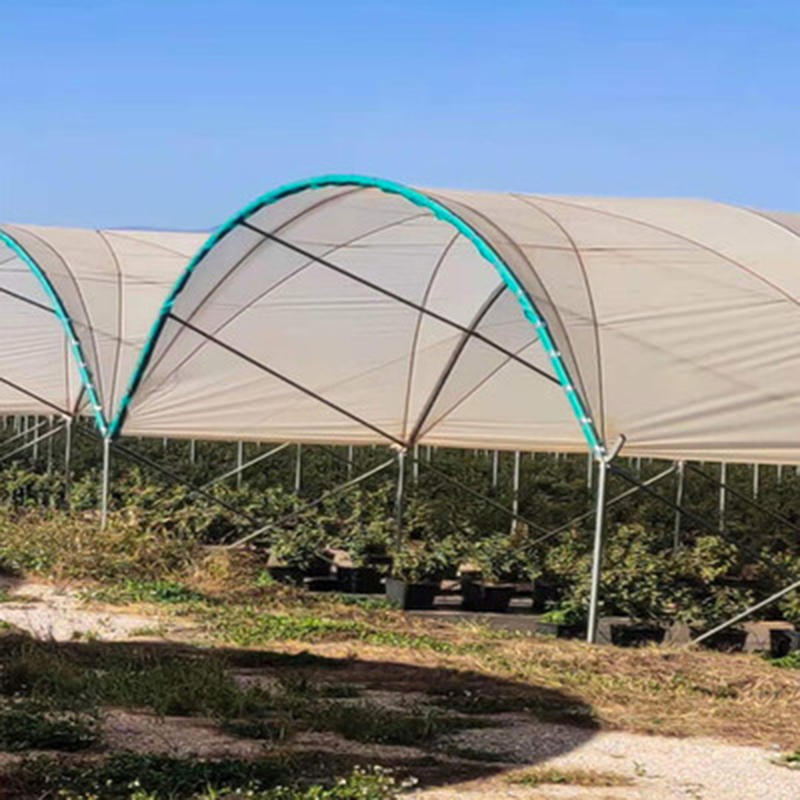
The core adaptation logic of the blueberry rain shelter is to “isolate direct rain scouring, reduce diseases caused by high humidity environment (such as gray mold and anthracnose), and avoid fruit cracking”, while ensuring sufficient light and ventilation. It is specifically applicable to the following climate types:
Subtropical Humid Climate (Rainy Area)
Typical Features: Annual precipitation 1200~2000 millimeters, precipitation concentrated in the flowering period (March~April) and fruit expansion period (May~June), high temperature and humidity in summer (30℃~35℃, humidity 70%~90%), and continuous rain in spring and autumn.
Adaptation Logic: Rain shelter during the flowering period can prevent pollen from being washed away and improve the fruit setting rate; rain shelter during the fruit period avoids fruit cracking caused by rainwater seeping into the fruit (the fruit cracking rate can be reduced from 30% to below 5%), and at the same time reduces the humidity inside the shelter and the breeding of fungal diseases; in summer, the combination of “rain shelter film + sunshade net” relieves the stress of high temperature and humidity and prolongs the fruit picking period.
Representative Climate Zones: Yangtze River Basin (Zhejiang, Jiangsu, Anhui, Hunan, Hubei), Pearl River Delta (Guangdong, Guangxi), southeastern United States (Georgia, Florida), southern Kyushu Island of Japan, etc.
Temperate Monsoon Climate (Semi-Humid and Rainy Area)
Typical Features: Annual precipitation 600~1200 millimeters, concentrated precipitation in summer (accounting for 60%~70% of the whole year), frequent rainstorms, occasional rain in spring and autumn, and cold and dry winter.
Adaptation Logic: Rain shelter during the summer fruit ripening period (June~July) prevents fruit cracking caused by rainstorms and root rot caused by soil waterlogging; rain shelter in autumn can reduce diseases during the flower bud differentiation period and ensure the output of the next year; the rain shelter film can be removed in winter to use natural snow for thermal insulation, or covered with an insulation curtain to assist overwintering.
Representative Climate Zones: North China Plain (Shandong, Hebei, Henan), southern Northeast China (Liaoning, southern Jilin), central South Korea, southern Honshu Island of Japan, etc.
Plateau Mountain Climate (Rainy River Valley Area)
Typical Features: Altitude 1000~2000 meters, annual precipitation 800~1500 millimeters, mostly night rain and orographic rain, large temperature difference between day and night (15℃~20℃), cool summer (20℃~28℃), and abundant sunlight but concentrated rain.
Adaptation Logic: The rain shelter can isolate night rain, avoid long-term wetting of leaves and fruits, and reduce the risk of downy mildew and powdery mildew; combined with a sunshade net under strong sunlight, it prevents fruit sunburn, and at the same time retains sufficient light to promote sugar accumulation (the soluble solid content of blueberries can be increased by 1~2 percentage points).
Representative Climate Zones: Yunnan-Guizhou Plateau (Kunming, Yuxi, Yunnan, Qiandongnan, Guizhou), mountains around the Sichuan Basin, river valleys of the South Island of New Zealand, etc.
Temperate Marine Climate (Mild and Rainy Area)
Typical Features: Mild and humid throughout the year, annual precipitation 1000~1500 millimeters, no obvious dry season, cool summer (20℃~25℃), mild winter (5℃~10℃), and moderate sunlight.
Adaptation Logic: Annual rain shelter can significantly reduce diseases caused by high humidity environment, avoid quality degradation caused by long-term dampness of the fruit surface (such as weak taste and uneven coloring); combined with a ventilation system in a mild climate, it ensures air circulation inside the shelter and maintains the appropriate humidity (50%~60%) for blueberry growth.
Representative Climate Zones: Shandong Peninsula, Liaodong Peninsula, western Europe (the United Kingdom, northwestern France), northwestern Pacific coast of the United States (Washington State, Oregon), etc.
Inapplicable Climate:
Extremely Arid and Rainless Areas (annual precipitation <400 millimeters, such as inland Northwest China and deserts in Central Asia): No rain shelter is needed, and the rain shelter will hinder natural precipitation, increase irrigation costs, and the cost performance is lower than that of outdoor planting;
Tropical Rainstorm and Typhoon Areas (such as Hainan, China and Southeast Asia): Short-term heavy rain and typhoons are easy to damage the shelter structure, and in high temperature and high humidity environment, even with rain shelter, it is difficult to fully control diseases, requiring additional huge investment in wind and rain resistance facilities;
Severe Cold and Rainless Areas (below -20℃ with scarce precipitation, such as northern Heilongjiang): Blueberries need to be buried in soil for overwintering, the cost of building and removing the rain shelter is high, and there is no rainfall stress in winter, so no rain shelter function is needed.
II. Applicable Regions: Concentrated Areas Combining Blueberry Industry Layout and Rainfall Distribution
The core of the regional distribution of blueberry rain shelters is “blueberry main producing areas”, “areas where precipitation is concentrated and overlaps with the blueberry growth period”, and “around high-end markets”, focusing on the following regions:
Core Applicable Regions in China
Southern Blueberry Main Producing Areas:
Yangtze River Basin: Lin’an, Zhejiang (the largest concentration area of blueberry rain shelters in the country, accounting for 25% of the national total), Lishui, Jiangsu, Chizhou, Anhui, Changsha, Hunan, focusing on highbush blueberries and rabbiteye blueberries. Rain shelters are used to ensure fruit quality and supply high-end markets in the Yangtze River Delta and Pearl River Delta;
Yunnan-Guizhou Plateau: Qujing, Yuxi, Yunnan, Qiannan, Qiandongnan, Guizhou, focusing on early-maturing blueberry varieties (such as “Sharpblue”, “Misty”). Rain shelters combined with strong plateau sunlight realize listing in early May, seizing the early market;
Pearl River Delta: Heyuan, Meizhou, Guangdong, Guilin, Guangxi, focusing on protected cultivation. Rain shelters are used for off-season planting (fruiting in November~December by regulating temperature) to supply high-end supermarkets in Hong Kong, Macao and South China.
Northern Blueberry Main Producing Areas:
North China Plain: Qingdao, Linyi, Shandong, Qinhuangdao, Hebei, focusing on half-highbush blueberries. Rain shelters are mainly used for rain shelter and fruit cracking prevention during the summer fruit ripening period (June~July), and drip irrigation systems are supporting to solve the drought problem;
Southern Northeast China: Dandong, Dalian, Liaoning, Tonghua, Jilin, focusing on cold-resistant blueberry varieties (such as “Bluecrop”, “Northland”). Rain shelters are used for rain shelter and frost prevention during the spring flowering period (April~May) to improve the fruit setting rate;
Shandong Peninsula and Liaodong Peninsula: Mainly temperate marine climate adaptation areas, rain shelters are used throughout the year to plant high-end blueberry varieties (such as “O’Neal”, “Tianhou”) to supply high-end northern markets and exports.
International Applicable Regions
Asia: Kyushu Island, Japan (Fukuoka, Nagasaki), Gyeonggi-do, South Korea, central Israel (rain shelter cultivation of drought-tolerant blueberry varieties), rain shelters are used to improve fruit quality and export to high-end Asian markets;
Europe: Northern Spain, southwestern France, northern Italy, blueberry rain shelters combined with greenhouse regulation realize annual supply to supply European supermarkets;
America: Southeastern United States (Georgia, Florida), northwestern Pacific coast (Washington State), rain shelters are used for large-scale blueberry planting to reduce disease losses and ensure export quality;
Oceania: Southeastern Australia (Victoria), North Island of New Zealand, rain shelters are used for early-maturing blueberry cultivation to export to Asian markets.
Key Factors for Regional Adaptation:
Climate Conditions: Annual precipitation above 600 millimeters, and precipitation concentrated in the blueberry flowering period (March~April) or fruit period (May~July);
Soil Conditions: Acidic soil (pH value 4.0~5.5) with good drainage (rain shelters need to be combined with ridge cultivation to avoid waterlogging inside the shelter);
Industrial Foundation: Large-scale blueberry planting (single garden area above 50 mu, adapting to the construction cost of rain shelters), with supporting technologies such as seedlings, water and fertilizer management, and disease prevention and control;
Market Demand: Close to cities or high-end consumer markets (such as first-tier cities and export ports) to support the premium brought by rain shelter cultivation (the price of rain-sheltered blueberries is 20%~50% higher than that of outdoor blueberries).
III. Applicable Fields: Focus on Core Scenarios of “Quality Improvement + Large-Scale Planting”
With the advantages of “rain shelter and disease prevention, stable quality, and extended production period”, blueberry rain shelters are mainly used in blueberry large-scale planting, high-end fruit production, sightseeing picking and other fields, including:
Large-Scale Blueberry Planting Field (Core Application)
Large-Scale Production of High-End Fresh Fruits: Blueberry rain shelters in Zhejiang, Shandong and Yunnan are used for large-scale planting of high-end varieties (such as “O’Neal”, “Misty”, “Tianhou”). Through rain shelter, fruit cracking and diseases are reduced, the fruit commodity rate is increased from 60% outdoors to more than 90%, and the per mu yield can reach 800~1200 kilograms, supplying high-end supermarkets (such as Hema, Sam’s) and e-commerce platforms nationwide;
Cultivation of Early-Maturing/Late-Maturing Varieties: Rain shelters in Yunnan and Guangdong combined with heating equipment realize early-maturing listing of blueberries in March~April; rain shelters in Liaoning and Shandong combined with insulation curtains extend the fruit picking period to August~September, seizing the off-peak market with a premium of 50%~100%;
Export Blueberry Bases: Blueberry rain shelter planting bases in Qingdao, Shandong and Dalian, Liaoning, standardized production (such as unified bagging, precise water and fertilizer) meet the inspection and quarantine requirements of international markets such as the European Union and Japan, and the export unit price is 2~3 times that of the domestic market.
Protected Blueberry Seedling Cultivation Field
Blueberry Seedling Propagation: Rain shelters in Lin’an, Zhejiang and Linyi, Shandong are used for cultivating blueberry cuttings and tissue culture seedlings. Rain shelter can control the humidity of the seedbed, avoid seedling root rot and diseases (such as damping-off), and the survival rate is increased from 70% outdoors to more than 95%;
Variety Domestication and Cultivation: Rain shelters of agricultural scientific research institutions (such as the Chinese Academy of Agricultural Sciences and Zhejiang Academy of Agricultural Sciences) are used for domestication of introduced blueberry varieties. Through rain shelter to regulate the environment, excellent varieties adapted to the local climate (such as heat and humidity resistant, fruit cracking resistant varieties) are selected.
Sightseeing Picking and Cultural Tourism Agriculture Field
High-End Sightseeing Picking Gardens: Blueberry rain shelters around cities such as Beijing, Shanghai and Guangzhou build high-end picking gardens. The rain shelter environment improves the tourist picking experience (avoiding muddy roads and fruit contamination by mud in rainy days), supporting parent-child interaction, popular science explanation and other services, with a per capita consumption of 150~200 yuan (50% higher than outdoor picking);
Cultural Tourism Scenic Spot Supporting: Blueberry rain shelters in scenic spots such as Yuxi, Yunnan and Qiandao Lake, Zhejiang serve as supporting cultural tourism projects, combining blueberry picking, blueberry wine tasting, rural homestays and other formats, extending the tourist stay time and improving the comprehensive income of the scenic spot.
Scientific Research and Experiment Field
Research and Development of Blueberry Cultivation Technology: Rain shelters of scientific research institutions are used for experiments on blueberry water and fertilizer management, disease prevention and control, variety improvement, such as research on “the impact of different rain shelter film materials on blueberry quality” and “green prevention and control technology of blueberry diseases and insect pests under rain shelter conditions”, providing technical support for large-scale planting;
Screening of Stress-Resistant Varieties: High humidity environment is simulated through rain shelters to screen blueberry varieties resistant to fruit cracking and diseases, or to cultivate special varieties resistant to heat and humidity and drought (such as improved rabbiteye blueberry varieties adapted to rainy areas in southern China).
Deep Processing Raw Material Planting Field
Blueberry Deep Processing Raw Material Bases: Blueberry rain shelters in Tonghua, Jilin and Yichun, Heilongjiang are used for planting raw materials of blueberry jam, fruit juice and fruit wine. Rain shelter can ensure the uniformity and sugar content of raw material fruits (soluble solids ≥12%), improving the quality of deep processing products;
Functional Food Raw Material Planting: Blueberry rain shelters in Jiangsu and Zhejiang are used for anthocyanin extraction and blueberry health product production. Rain shelter cultivation can increase the anthocyanin content of fruits (10%~20% higher than that of outdoor), meeting the raw material requirements of functional foods.