I. Applicable Climate: Focusing on the Core Needs of “Mild Regulation + Large-Scale Adaptation”
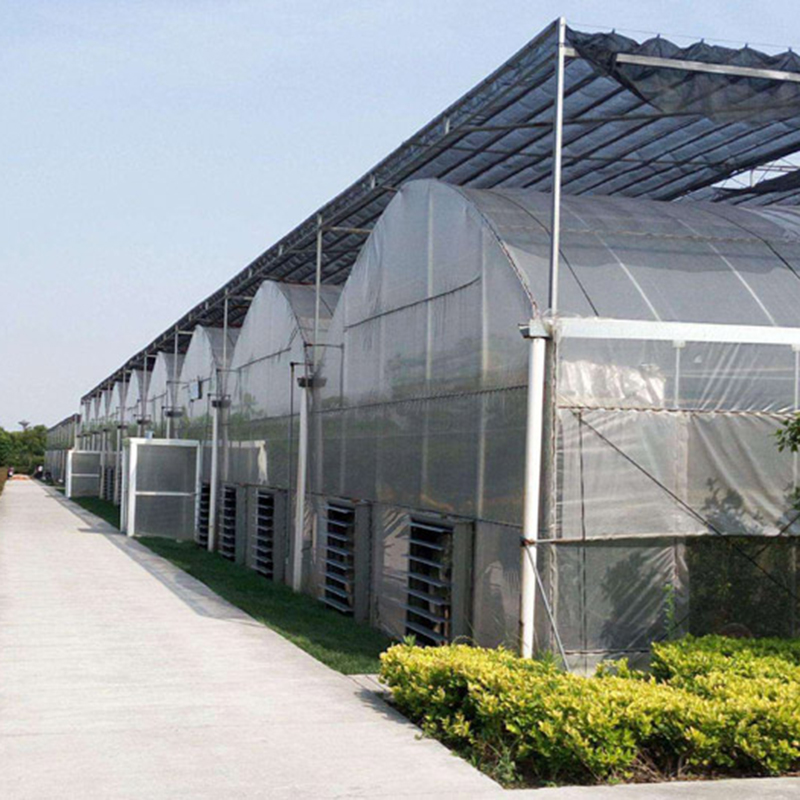
The core advantages of the multi-span greenhouse are continuous space, convenient mechanized operation and high efficiency of temperature and humidity regulation. Its climate adaptability focuses on three scenarios: “large-scale planting needed”, “easy temperature and humidity regulation” and “avoiding extreme weather damage”, and it is specifically applicable to the following climate types:
Temperate Monsoon Climate (Semi-Humid Zone)
Typical Characteristics: Cold winter (low temperature -10℃~-20℃), hot and rainy summer (precipitation concentrated in June ~ August), mild spring and autumn with sufficient sunlight, and distinct four seasons.
Adaptation Logic: In winter, it can be equipped with quilt / thermal insulation quilt + central heating system to realize large-scale overwintering planting; in summer, it relieves high temperature and high humidity stress through top window opening, side wall ventilation + wet curtain cooling; the temperature difference in spring and autumn is moderate, which is conducive to the regulation of crop growth cycle, and the open space can reduce the local pressure of monsoon on the greenhouse.
Representative Climate Zones: North China Plain (Hebei, Shandong, Henan), southern Northeast China (Liaoning), central Korean Peninsula, etc.
Subtropical Humid Climate (Sunny Zone)
Typical Characteristics: Mild winter (low temperature 0℃~-5℃), hot and humid summer (abundant precipitation), rainy but sunny spring and autumn, and long frost-free period.
Adaptation Logic: No heavy insulation is needed in winter, and simple film covering + local insulation can meet the needs of crops; in summer, the three-dimensional ventilation design of the multi-span greenhouse (top window + side window + fan) is relied on to reduce humidity and avoid diseases; the large-scale space is suitable for off-season planting and seedling raising, adapting to the dense market demand in the south.
Representative Climate Zones: Yangtze River Basin (Zhejiang, Jiangsu, Hunan, Hubei), northern Pearl River Delta, southeastern United States (northern Florida), eastern Australia (New South Wales), etc.
Temperate Continental Climate (Oasis and Plain Zones)
Typical Characteristics: Severe winter (low temperature -20℃~-30℃), hot and dry summer, large temperature difference between day and night, extremely sufficient sunlight, and little precipitation.
Adaptation Logic: In winter, three-layer insulation of “thick film + quilt + inner insulation curtain” is adopted, combined with sufficient sunlight to store heat, meeting the overwintering of large-scale crops; in summer, it is dry and less rainy, and the sunshade system + ventilation design of the multi-span greenhouse can effectively cool down without complex dehumidification equipment; the dry climate is conducive to the maintenance of greenhouse materials (steel, film) and extends the service life.
Representative Climate Zones: Xinjiang Oasis Zone (Urumqi, Changji), Hexi Corridor of Gansu, Ningxia Plain, Syr Darya Plain of Central Asia, etc.
Plateau Mountain Climate (Low Altitude Valley Zones)
Typical Characteristics: Altitude 1000~2000 meters, cold winter (low temperature -15℃~-25℃), cool summer, strong sunlight, large temperature difference between day and night, and little precipitation.
Adaptation Logic: The central heating design of the multi-span greenhouse (such as floor heating and hot air furnace) can effectively resist low temperature, and cooperate with strong sunlight to increase the temperature inside the greenhouse; the open space is suitable for large-scale cultivation of plateau characteristic crops (flowers and Chinese medicinal materials), avoiding the inefficiency of scattered management of single-span greenhouses.
Representative Climate Zones: Central Yunnan (Kunming, Yuxi), western Guizhou (Liupanshui), eastern Qinghai (Xining), South Island Valley of New Zealand, etc.
Unsuitable Climate:
Extremely Severe Cold and No Sunlight Zones (below -35℃ and insufficient sunlight, such as northern Heilongjiang and Siberia): The insulation cost is huge, and the cost performance is lower than that of single-span greenhouses;
Tropical Climate (high temperature and high humidity throughout the year, such as Southeast Asia and Hainan Island in China): No insulation is needed, and the ventilation efficiency of multi-span greenhouses is not as good as open-field cultivation + sunshade net, with high cost;
Typhoon-Prone Zones (such as the southeast coast of China and southern Japan): The multi-span greenhouse has a large span, and its typhoon resistance is weaker than that of single-span greenhouses, which is prone to greenhouse collapse;
Extremely Rainy Zones (such as southern Fujian in China and Southeast Asian rainforests): High humidity is easy to cause steel corrosion and film aging, and the drainage of large-scale greenhouses is difficult, which is prone to waterlogging and root flooding.
II. Applicable Regions: Concentrated Distribution Combined with Large-Scale Industry and Market Demand
The core of the geographical distribution of multi-span greenhouses is “large-scale agricultural foundation”, “high market density” and “adaptation to mechanization level”, focusing on the following regions:
Core Applicable Regions in China
Northern Large-Scale Protected Agriculture Zones:
North China Plain: The largest concentration area of multi-span greenhouses in China (Shouguang in Shandong, Yongnian in Hebei, Fugou in Henan), accounting for more than 40% of the total multi-span greenhouses in China, used for large-scale off-season production of vegetables and flowers, supplying large cities such as Beijing, Tianjin and Shanghai;
Northwest Oasis Zones: Changji in Xinjiang, Jiuquan in Gansu, Yinchuan in Ningxia. Multi-span greenhouses are used for protected cultivation of tomatoes, peppers, grapes and other crops, exporting to Central Asia relying on the Silk Road Economic Belt;
Southern Northeast China: Haicheng and Gaizhou in Liaoning. Multi-span greenhouses mainly focus on seedling raising and off-season vegetable planting, supplying the winter market in the three northeastern provinces.
Southern Dense Market Adaptation Zones:
Yangtze River Basin: Jiaxing in Zhejiang, Suzhou in Jiangsu, Changsha in Hunan. Multi-span greenhouses are used for large-scale planting of leafy vegetables, strawberries and flowers, adapting to the dense consumer demand in southern cities;
Pearl River Delta: Foshan and Dongguan in Guangdong. Multi-span greenhouses mainly focus on high-end flowers (phalaenopsis, roses) and seedling raising, supplying Hong Kong, Macao and the South China market;
Yunnan-Guizhou Plateau Valleys: Jinning in Kunming and Tonghai in Yuxi, Yunnan, the largest concentration area of flower multi-span greenhouses in China, with annual output of cut flowers accounting for more than 30% of the total in China.
International Applicable Regions
Asia: Central Honshu Island, Japan (Shizuoka, Tochigi), Gyeonggi-do, South Korea, Central Plain of Israel (around Tel Aviv), western Anatolian Plateau, Turkey. Multi-span greenhouses are used for large-scale production of vegetables and flowers, adapting to the market demand of high-density population;
Europe: Western Netherlands (Randstad region), southern Germany (Bavaria), eastern France (Alsace region), the core area of global high-end multi-span greenhouse technology, used for industrial production of greenhouse vegetables, berries and flowers, exported to the world;
America: Central Valley of California, USA, central Florida, southern Ontario, Canada. Multi-span greenhouses are used for off-season vegetable and seedling cultivation, supplying the North American continental market;
Oceania: Eastern Australia (southern Queensland), North Island of New Zealand. Multi-span greenhouses are used for large-scale planting of fruits (kiwifruit, grapes) and flowers, exported to the Asian market.
Key Factors for Regional Adaptation:
Industrial Foundation: It needs to have large-scale agricultural supporting facilities (such as seedling bases, agricultural material supply, cold chain logistics);
Market Demand: Around urban dense areas or export ports (such as coastal cities and border ports in China) to reduce transportation costs;
Technical Conditions: The local mechanization level is relatively high (such as tillers, water and fertilizer integrated machines, and picking equipment can adapt to the space of multi-span greenhouses);
Policy Support: Agricultural modernization demonstration zones and protected agriculture subsidy areas (such as the core area of China’s “vegetable basket” project).
III. Applicable Fields: Focusing on Large-Scale and Intensive High-End Application Scenarios
With the advantages of “continuous space, convenient mechanization and precise regulation”, multi-span greenhouses are mainly used in fields with high large-scale and intensive levels, including:
Large-Scale Vegetable Planting Field (Core Application)
Industrial Production of Off-Season Vegetables: Multi-span greenhouses in North China and Northwest China are used for large-scale planting of thermophilic vegetables such as cucumbers, tomatoes, green peppers and eggplants in winter. The area of a single greenhouse can reach 5000~10000 square meters. Combined with water and fertilizer integration and environmental monitoring systems, the per mu yield is 20%~30% higher than that of single-span greenhouses, supplying the national market;
Annual Supply of Leafy Vegetables: Multi-span greenhouses in the south (Zhejiang, Jiangsu) plant leafy vegetables such as lettuce, oilseed rape and Chinese flowering cabbage. Through shading and ventilation regulation, continuous harvesting throughout the year is realized to meet the daily distribution demand of cities;
Export Vegetable Bases: Multi-span greenhouses in Xinjiang and Yunnan are used for planting export vegetables such as tomatoes, carrots and onions. Large-scale production adapts to the standardized requirements of customs inspection and quarantine, reducing export costs.
Large-Scale Cultivation of Flowers and Seedlings
Industrial Cultivation of Cut Flowers: Multi-span greenhouses in Kunming and Yuxi, Yunnan focus on planting cut flowers such as phalaenopsis, roses and lilies. A single greenhouse can cultivate 100000~200000 plants. Through precise temperature control (25~28℃ during the day and 15~18℃ at night), the flowering period is ensured to be consistent, supplying the domestic and foreign holiday markets;
Large-Scale Seedling Cultivation: Multi-span greenhouses in Shandong and Jiangsu are used for cutting and grafting seedling raising of fruit tree seedlings (apple, pear, citrus) and greening seedlings (camphor tree, sweet osmanthus). Centralized management improves the survival rate (30% higher than that of open-field seedling raising), meeting the needs of large-scale afforestation and orchard construction;
Planting of Succulents and Ornamental Green Plants: Multi-span greenhouses in Guangdong and Fujian are used for large-scale cultivation of succulents, scindapsus aureus, monstera deliciosa and other ornamental green plants. The three-dimensional cultivation mode makes full use of space, adapting to the batch supply demand of e-commerce live streaming.
Chinese Medicinal Materials and Special Crop Fields
Large-Scale Planting of Chinese Medicinal Materials: Multi-span greenhouses in Yunnan and Guizhou are used for artificial cultivation of valuable Chinese medicinal materials such as panax notoginseng, dendrobium and paris polyphylla. Precise control of temperature and humidity (humidity 60%~70℃, temperature 18~25℃) avoids the uncertainty of the wild environment and improves the quality and yield of medicinal materials;
Cultivation of Berry Crops: Multi-span greenhouses in Shandong and Liaoning are used for off-season planting of berry crops such as strawberries, blueberries and raspberries. The large-scale space is convenient for picking management, adapting to the sightseeing picking and gift box sales mode;
Industrial Production of Edible Fungi: Multi-span greenhouses in Zhejiang and Fujian (transformed into constant temperature and humidity greenhouses) are used for industrial cultivation of shiitake mushrooms, enoki mushrooms and pleurotus eryngii. Centralized regulation of carbon dioxide concentration and humidity realizes continuous harvesting throughout the year.
Breeding and Seedling Auxiliary Fields
Large-Scale Seedling Raising of Livestock and Poultry: Multi-span greenhouses in Hebei and Shandong are used for centralized seedling raising of chicks, ducklings and piglets. Combined with floor heating, hot air furnaces and ventilation systems, the temperature inside the greenhouse is maintained at 25~30℃, reducing the risk of disease transmission and improving the seedling survival rate (15% higher than that of traditional sheds);
Aquatic Seedling Cultivation: Multi-span greenhouses in Jiangsu and Guangdong are used for overwintering and cultivation of fish, shrimp and crab seedlings. The greenhouse insulation maintains the water temperature at 15~20℃, avoiding seedling death caused by low temperature, and meeting the large-scale seedling demand of aquaculture;
Pet Breeding Greenhouses: Multi-span greenhouses in Guangdong and Zhejiang are used for breeding reptiles such as turtles and snakes, with precise temperature and humidity control, adapting to the large-scale supply of the pet market.
Scientific Research and Tourism Agriculture Fields
Agricultural Scientific Research Experiments: Multi-span greenhouses of national agricultural academies of sciences (such as Chinese Academy of Agricultural Sciences and Shandong Academy of Agricultural Sciences) are used for crop variety improvement, stress resistance experiments and cultivation technology research and development. The large-scale space can carry out multiple groups of experiments at the same time, improving research efficiency;
Sightseeing Picking Gardens: High-end sightseeing picking gardens are built with multi-span greenhouses around cities such as Beijing, Shanghai and Guangzhou, integrating vegetable, fruit and flower planting, and providing one-stop picking and experience services. The open space of multi-span greenhouses improves the tourist experience;
Science Popularization and Education Bases: Multi-span greenhouses of primary and secondary schools and agricultural colleges and universities are used as science popularization and education bases to display protected agricultural technologies and crop growth cycles, and enhance the intuitiveness of science popularization through large-scale scenes.